

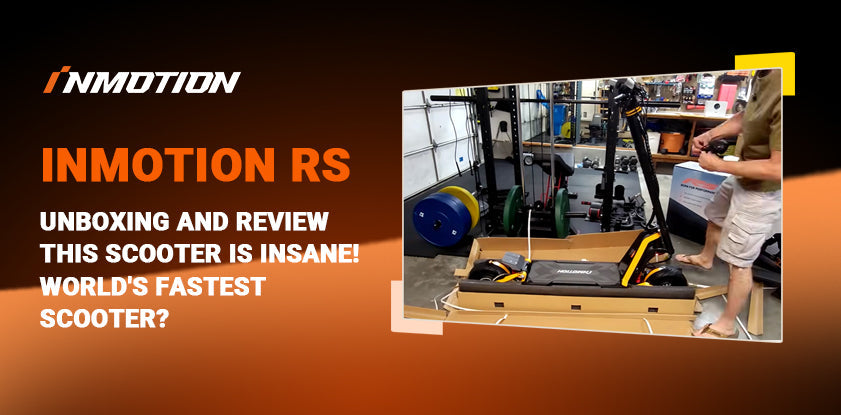

If an electric scooter offers near-motorcycle acceleration, a claimed top speed of around 110 km/h (68 mph), and a suspension system whose height can be adjusted for pavement or rough terrain, is it still an ordinary commuter scooter?
The INMOTION RS clearly is not.
As INMOTION's flagship high-performance electric scooter, the RS combines dual-motor power, long range, adjustable ride height, hydraulic braking and smart app settings on a single platform. YouTube creator ETPC put the INMOTION RS through a complete unboxing, assembly and real-world riding test, with particular attention to its stability at high speed.
This article breaks down that test: real-world speed, acceleration, suspension design, braking, smart features and who the RS is actually for.
Safety note: The INMOTION RS is a high-performance electric scooter. High-speed testing should only be carried out in legal, closed and controlled environments, wearing full protective gear including a full-face helmet, body armour, gloves and knee pads. Always check your local regulations before riding.

INMOTION RS key specifications at a glance
| Item | Specification or tested result |
| Positioning | Flagship high-performance electric scooter |
| Claimed top speed | About 68 mph / 110 km/h |
| Tested speed in video | About 56-59 mph / 90-95 km/h |
| Drivetrain | Front and rear dual motors |
| Claimed range | Up to about 100 miles / 160 km |
| Suspension | Adjustable front and rear, multiple ride-height settings |
| Brakes | Front and rear hydraulic disc brakes |
| Tires | 11-inch tubeless street tires |
| Riding modes | Eco, D, X and more |
| Smart features | Motor output tuning, electronic braking, temperature monitoring, anti-theft lock |
| Weight | Over 100 lb / more than 45 kg |
Keep in mind that top speed and range are affected by rider weight, road surface, gradient, tire pressure, ambient temperature, riding mode and battery level.

1. Unboxing and assembly: industrial build, serious heft
The first impression the INMOTION RS gives is not lightness, it is solidity.
From [00:27] in the video you can see that the main body of the RS arrives largely pre-assembled. You only need to fit the handlebars, rear fender and reflective parts to finish the basic build.
The process is not complicated, but because of the machine's weight, two people should handle unboxing and assembly.
Extensive metal structure reinforces the frame
At [00:55] ETPC shows the frame and its connecting components. The RS uses a lot of heavy metal structure, with clear reinforcement around the steering tube, swingarms and frame joints.
The benefits of this design include:
- Greater chassis rigidity at high speed
- Less play in the steering tube and frame joints
- Ability to handle stronger acceleration and braking forces
- Better durability on rough surfaces
The trade-off is direct: the RS is not suited to being carried up stairs regularly, loaded into a car trunk, or moved around a building without an elevator.

2. Adjustable ride height: why the RS is called a "transformable" scooter
One of the most distinctive features of the INMOTION RS is a suspension design that changes the ride height and riding posture.
At [04:51] the video shows the multiple adjustment positions on the front and rear swingarms. By changing the mounting holes, the rider alters ground clearance and vehicle geometry.
Low centre of gravity, road mode
A lower stance suits smooth pavement and high-speed cruising:
- Lowers the overall centre of gravity
- Improves straight-line stability at speed
- Reduces pitching under hard acceleration and braking
- Gives a handling feel closer to a road performance machine
High ground clearance mode
Raised up, the RS gains clearance for gravel, undulating ground and some unpaved roads. A taller chassis reduces the chance of scraping the underside over bumps, ramps and uneven surfaces.
That does not mean the RS can handle any off-road environment. Tire type, suspension setup, speed and conditions all still affect safety.

3. Adjustable suspension: comfort and support set separately
Beyond ride height, the damping of the INMOTION RS suspension can also be tuned.
At [05:19] you can see the rider changing the suspension feel via the adjustment knobs.
A softer setting suits:
- City roads
- Small, sharp bumps
- Long-distance cruising
- Riders who prioritise comfort
A firmer setting suits:
- Hard acceleration and braking
- Higher speeds
- Heavier riders
- Situations where you want less body pitch
A sensible setup depends on rider weight, tire pressure and the surfaces you ride most. Firmer is not automatically more stable, and softer is not automatically more comfortable.

4. Power delivery: acceleration is the RS's core selling point
The INMOTION RS uses front and rear motors, with output far above a typical commuter scooter.
At the highest output settings, instant torque can briefly break traction. For that reason, do not start your first ride in the most aggressive power mode.
Switching between single and dual motor
As shown at [03:09], the rider can switch between drive states.
Single-motor mode suits:
- Flat surfaces
- Lower-speed riding
- Saving energy
- Everyday use without strong acceleration demands
Dual-motor mode suits:
- Climbing
- Rapid acceleration
- Heavier loads
- Situations that need full power
Dual-motor mode does not mean full throttle all the time. On wet, gravelly or low-grip surfaces, excessive instant output increases the risk of losing control.

5. How fast is the INMOTION RS in practice?
The claimed top speed of the INMOTION RS is about 68 mph, or 110 km/h.
In ETPC's testing the scooter reached roughly 56-59 mph, about 90-95 km/h, shown around [08:45].
Tested speeds below the theoretical maximum are common, because top speed depends on:
- Rider weight
- Remaining battery charge
- Head or tail wind
- Road gradient
- Tire pressure
- Motor and controller temperature
- Power limits set in the app
- The current riding mode
More important than the headline number is whether the machine stays stable at speed.
At [16:54] ETPC notes that the RS kept its handlebars steady near the top tested speed, with no obvious speed wobble, often called "death wobble".
That said, one test without wobble does not guarantee it can never occur for any rider, road or setup. Tire condition, steering components, suspension settings, load distribution and rider input all affect high-speed stability.
6. Range: what does a claimed 160 km actually mean?
The claimed maximum range of the INMOTION RS is about 100 miles, or 160 km.
That figure normally represents an ideal result under specific test conditions. Real-world range can be noticeably different.
Battery drains faster with:
- Extended dual-motor use
- Frequent hard acceleration
- High-speed cruising
- Continuous climbing
- Cold weather
- Heavier riders
- Low tire pressure
- Extra cargo
Riding mostly in Eco or everyday mode at a steady speed gets you much closer to the claimed figure than repeatedly using maximum power.
So for long rides, do not plan your route around the official maximum range. Leave enough charge for the return trip and a safety margin.

7. Controls: cruise control and mode switching
The handlebar area integrates the controls you use most.
Cruise control
Cruise control is shown at [03:25]. Once engaged, the scooter holds a set speed, reducing throttle fatigue on long rides.
It works best where the road is clear, traffic is simple and the feature is permitted. Use it carefully around crowds, intersections and complex traffic.
Multiple riding modes
As shown at [11:58], the RS offers several modes:
- P mode: park or lock state
- Eco mode: reduced output for gentle riding and better efficiency
- D mode: everyday power response
- X mode: more aggressive power delivery
New RS owners should start in a milder mode and raise power settings only after getting familiar with the throttle, brakes and chassis feedback.
8. The INMOTION app: deep tuning for power and braking
The RS is not limited to handlebar buttons. The INMOTION app lets you adjust many vehicle settings.
Front and rear motor output
Motor output settings appear at [12:12]. You can change the power balance between front and rear motors. Reducing front-wheel output off the line, for example, helps limit front-wheel slip and steering instability during hard launches.
This is valuable for experienced riders, but new users should not simply max out every setting without understanding the effect.
Electronic braking
Around [12:24] you can see electronic brake strength and response settings. Stronger electronic braking gives clear deceleration feedback, but an overly aggressive setting can feel abrupt. Start at a medium level and adjust to your weight, speed and habits.
Temperature monitoring and diagnostics
The app also shows operating data:
- Front motor temperature
- Rear motor temperature
- Battery status
- Fault and diagnostic information
- Connection status
Temperature data matters most on long, fast or sustained climbing rides. If temperatures climb, reduce load and let the scooter cool.
Vehicle locking
App locking is shown at [10:11]. It adds security for short stops, but it should not replace a physical lock and a safe parking spot.
9. Braking: high performance needs matching stopping power
The INMOTION RS uses front and rear hydraulic disc brakes.
Based on the ride at [06:43], the brakes feel direct and provide the deceleration a fast machine needs.
Advantages of hydraulic discs include:
- Strong braking force
- Relatively linear feel
- Less finger effort required
- Easier precise control on long rides
Even so, strong brakes do not shorten stopping distance in every situation. Wet surfaces, gravel, tire wear and rider reaction time all matter.
Before each ride, check:
- Brake pad thickness
- Whether the rotors are warped
- Whether the brake levers feel unusually soft
- Tire pressure and wear
- That the steering tube and folding mechanism are locked
10. Lighting and night-time visibility
The RS has a headlight, tail light and turn indicators, shown at [01:31].
A complete lighting set improves night-time visibility, but fast night riding should not rely on stock lights alone. Consider reflective gear, extra auxiliary lighting and more conservative speeds.
Lights help other road users see you, but they do not remove the risk of blind spots, potholes and sudden obstacles.
11. 11-inch tires and real-world surface capability
The INMOTION RS runs 11-inch tubeless tires.
The larger diameter helps high-speed stability and improves how the scooter handles small potholes, expansion joints and gravel.
In ETPC's testing the RS stayed stable on pavement and also coped well with some gravel and unpaved sections, seen around [14:47].
Still, road-biased tires are not the same as dedicated off-road rubber. If you mostly ride mud, soft sand or technical trails, reassess grip and vehicle setup.
12. Main strengths of the INMOTION RS
Based on the unboxing and real-world test:
1. Strong dual-motor power. Very eager acceleration, plus the muscle for hills, loads and fast cruising.
2. Notable high-speed stability. ETPC's test showed steady chassis feedback around 90-95 km/h.
3. Adjustable ride height. Set it low for road speed or high for rougher ground.
4. Tunable suspension. Different weights and riding styles can find the right support and comfort.
5. Rich app settings. Motor output, electronic braking, temperature monitoring and locking make the RS highly customisable.
6. Long-distance potential. A large battery and cruise control support long commutes and touring.
13. Things to consider before buying
It is very heavy
As noted at [18:11], the scooter weighs over 100 lb, more than 45 kg.
That makes it a poor fit if you:
- Frequently carry it upstairs
- Live in a walk-up building
- Load it into a car trunk often
- Need to take it on public transport
- Want to carry it one-handed
Performance beyond ordinary commuting
If you only need short, low-speed trips, the RS's weight, power and size may be more than you need.
High performance demands more skill
The acceleration and speed are not for complete beginners riding at maximum settings. Even after buying, give yourself time to learn the power response, braking distances and suspension feedback.
14. Who is the INMOTION RS for?
- Advanced riders who want strong acceleration and high-speed performance
- Riders who need long range
- Enthusiasts who mix pavement with light unpaved roads
- Riders who value suspension and power customisation
- People with safe storage who do not need to carry the scooter often
- Riders willing to wear full protective gear and learn a high-performance machine step by step
If portability and simple commuting matter most to you, the RS is probably not the right choice.
15. Verdict: is the INMOTION RS worth buying?
The INMOTION RS is a flagship high-performance electric scooter with a very clear purpose.
Its appeal is not only the claimed 110 km/h top speed, but also dual-motor power, adjustable ride height, tunable suspension, hydraulic brakes and extensive app settings.
ETPC's test showed a real-world speed of roughly 90-95 km/h with stable handling at that pace. For riders chasing power, range and adjustability, that is compelling.
It is not for everyone, though. More than 45 kg means it is hard to move around, and the acceleration and speed demand mature riding habits and safety awareness.
Put simply: the INMOTION RS is not a light everyday scooter. It is a high-performance electric platform you tune to the road and your riding style.
If your priorities are strong power, high-speed stability, long-distance capability and deep adjustability, the INMOTION RS deserves serious consideration.
INMOTION RS frequently asked questions
What is the top speed of the INMOTION RS?
The claimed top speed is about 68 mph, or 110 km/h. ETPC reached roughly 56-59 mph, about 90-95 km/h, in video testing. Real speed depends on rider weight, charge, road conditions, temperature and settings.
What is the range of the INMOTION RS?
The claimed maximum range is about 100 miles, or 160 km. High speeds, frequent hard acceleration, dual-motor operation, cold weather and climbing all reduce real-world range.
Can the INMOTION RS go off-road?
The RS can be raised and its suspension adjusted, so it handles gravel and some unpaved roads. Actual capability still depends on tires, conditions, speed and rider experience; it is not a dedicated off-road motorcycle.
Is the INMOTION RS suitable for beginners?
Complete beginners should not start at maximum power settings. New riders should begin in lower power modes, get used to the throttle, brakes and steering in a closed area, and wear full protective gear.
How heavy is the INMOTION RS?
It weighs over 100 lb, more than 45 kg. Check your storage, charging and lifting situation before buying.
Does the INMOTION RS support a phone app?
Yes. The INMOTION app shows vehicle status, adjusts some power and electronic braking settings, monitors temperature, and offers locking and diagnostics.
Does the INMOTION RS get speed wobble?
No obvious speed wobble appeared in ETPC's test, but that does not guarantee it cannot happen with other setups or roads. Tires, suspension, steering components, load and rider input all affect high-speed stability.
Share:
The Benefits of Using Electric Scooters for Last-Mile Transit Solution